
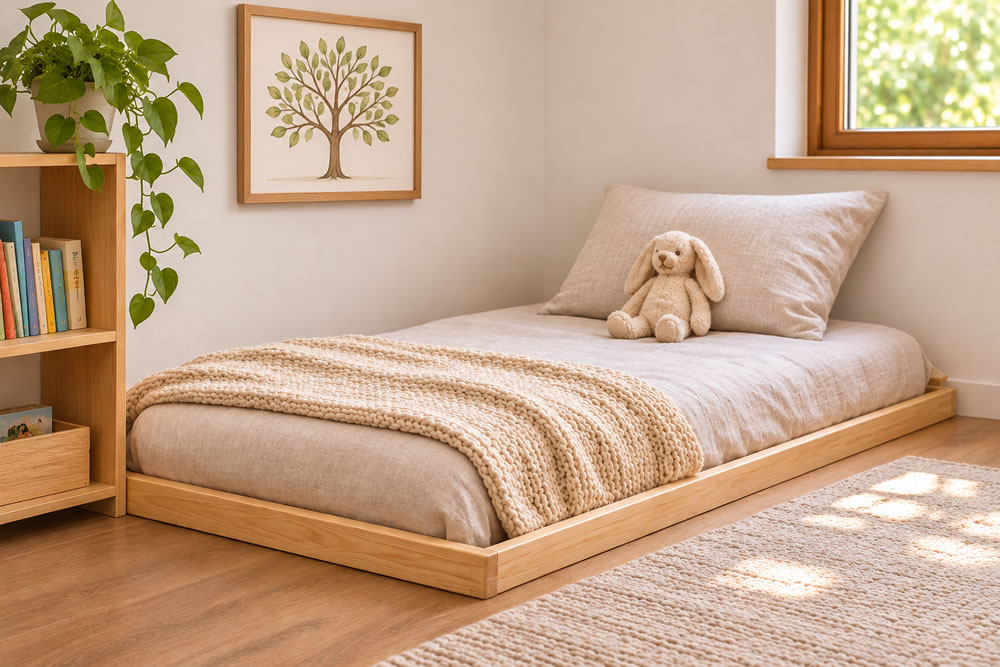
A Montessori floor bed sits close to the ground so a child can get in and out independently. When choosing the right bed, consider your child’s age, the bed’s design, and everything that can be reached in the room.
This guide explains when families usually switch from a crib to a bed, what to check before buying, and how to prepare bedrooms before changing your child’s sleep setup.
Montessori Floor Bed Guide - Table of Contents
- What Is a Montessori Bed?
- What Age Is Right for a Montessori Floor Bed?
- Safe Sleep for Babies Under 12 Months
- Choosing a Montessori Floor Bed
- How to Prepare the Room
- Helping Your Child Adjust
- Frequently Asked Questions
- Supporting Independence at Lakewood
- Key Takeaways
What Is a Montessori Bed?
A Montessori bed is a low sleeping space that lets a child get in and out without being lifted over crib rails. Some families simply place a mattress on the floor, while others choose a low frame designed specifically for a child’s age and size.
Whichever option you choose, the floor bed’s Montessori connection centers around accessibility. Just as a low shelf lets children choose a book themselves, a low bed can let a child participate more independently in bedtime and waking routines.
Of course, there’s plenty more you can do to bring Montessori ideas home before or after a new bed is built. Choosing pajamas, putting clothes in a hamper, and selecting a bedtime story also give children opportunities to do things themselves. Check out our Montessori Parenting guide for more ways to make everyday spaces, including bedrooms, easier for children to use.
What Age Is Right for a Montessori Floor Bed?
There is no single age when every child becomes ready; even a product’s minimum age won’t tell you whether your child is ready. The timing depends on your child’s development, the bed’s requirements, and the safety of the room.
For some general recommendations, Nationwide Children’s Hospital describes the crib-to-bed transition usually occurring between 2 and 3½ years old. But some transition earlier.
So how do you know when your child is developmentally ready?
Watch for Crib Safety Limits
Climbing makes the decision a lot easier. If your child can climb out or reaches the crib manufacturer’s height or other limits, stop using the crib and discuss an appropriate replacement sleep space with your pediatrician.
One thing you should not do is simply remove a crib side so your child can get easily in and out. That is, unless the manufacturer specifically provides instructions for that kind of conversion. A crib should only be used in its intended configurations for your child’s safety.
Understand the 15-Month Minimum
The Consumer Product Safety Commission’s toddler bed guidance defines toddler beds as intended for children at least 15 months old and weighing no more than 50 lbs.
That minimum age applies only to toddler beds, however. A larger twin-size frame marketed as a “Montessori bed” may have different age and size requirements. Always check the bed’s age, weight, and mattress limits, and discuss your child’s readiness with your pediatrician.
Safe Sleep for Babies Under 12 Months
For babies under 12 months, follow the American Academy of Pediatrics’ safe-sleep recommendations:
- Place babies on their backs for every nap and nighttime sleep.
- Use a firm, flat mattress in a crib, bassinet, portable crib, or play yard that meets CPSC standards.
- Use only the mattress intended for that product and a tightly fitted sheet.
- Do not put pillows, blankets, bumpers, stuffed animals, and other loose items in the crib.
- Share a room, with separate sleep spaces, for at least the first six months.
Being able to crawl, pull up, or walk does not replace these recommendations. The word “Montessori” on a product listing also does not establish that it meets infant sleep standards.
You can support movement and independence during supervised awake time while continuing to use an appropriate infant sleep space.
Choosing a Montessori Floor Bed
Start with the product’s instructions and safety information. Look for clear age and weight limits, required mattress dimensions, assembly directions, and information about compliance with applicable safety standards.
Important: A low bed can still have spaces where a child becomes trapped. In 2023, the CPSC recalled certain Montessori floor beds because their rail openings created entrapment and strangulation hazards. Check the model against current recalls before acquiring it.
Match the Mattress to the Frame
Use the manufacturer’s recommended mattress size and thickness. Gaps around the mattress, rails, or nearby furniture can create places where a child becomes caught. Avoid filling gaps with pillows, rolled towels, or stuffed animals. If the mattress does not fit as instructed, stop using the setup and contact the manufacturer.
Be Careful With Added Rails and Decorations
The CPSC explains that portable children’s bed rails are for children who can get in and out of an adult bed independently, typically ages 2 to 5; they are not a general solution for making any floor bed suitable for a younger child. Also, keep canopies, hanging cords, and decorative fabric away from the sleeping area. And lastly, assemble the bed exactly as directed, and check regularly for loose hardware or damaged parts.
How to Prepare the Room
Once your child can leave the bed, they can also explore their room before you wake up. Use this checklist as a starting point when considering what they can reach, pull, open, or climb.
- Anchor furniture: Secure dressers, bookcases, and other furniture to the wall to prevent them from tipping. Anything children can climb needs checking.
- Check windows and cords: Keep beds and climbable furniture away from windows. Use cordless window coverings and appropriate window safety devices. Screens don’t prevent falls, so be mindful of when you open and close windows in your child’s room.
- Remove accessible hazards: Store medicines, creams, cleaning products, small objects, and batteries securely, cover outlets, and make electrical cords inaccessible.
- Plan for wandering: Consider where your child could go after leaving the room. Restrict access to stairs, bathrooms, exterior doors, and other hazards with appropriate safety devices. Gates at the top of stairs should be mounted to the wall.
- Keep adult access clear: Keep the path to your child unobstructed, check that safety devices allow adults quick access, and test smoke alarms regularly.
Pro-tip: Get down to your child’s height and look around before the first night. Recheck as they grow, since a drawer or handle that was out of reach last month may be accessible now. A monitor can help you hear or see your child, but the room still needs these precautions.
Keep the Sleep Area Simple
Leave a clear space around the bed and avoid piling nearby toys or furniture against it. Follow the mattress and frame care instructions, including requirements for support, airflow, and keeping materials dry.
For Houston-area families, check beneath a low mattress during routine cleaning, especially after spills or accidents. If you find dampness, address it before using the bed again.
Helping Your Child Adjust
Although a new bed gives your child more freedom to move around, they may still need time to adapt to the new experience. Keep familiar parts of bedtime, such as brushing teeth, reading together, and saying goodnight, in the same order.
Before the first night, let your child explore the bed while you’re nearby. Show them how to get in and out and explain what happens after lights go out in simple language. If they get up, calmly guide them back and keep the interaction brief.
Frequently Asked Questions
Does a Montessori Floor Bed Help Children Sleep Better?
A floor bed allows easier access in and out of bed for an older child, but it does not guarantee longer sleep or fewer wakings. Consider whether the setup fits your child’s needs and whether your family can maintain a safe room and consistent routine.
Can I Put a Crib Mattress on the Floor?
In its guidance for toddlers moving out of cribs, HealthyChildren.org mentions a crib mattress on the floor as a temporary option while waiting for a bed. That advice concerns toddler transitions only. It should not be read as permission to replace an infant’s standards-compliant sleep space with a loose mattress.
Is a Floor Bed Required for Montessori Parenting?
No. Your child can develop independence through everyday tasks, accessible storage, and opportunities to make choices. A floor bed is one option when it suits your child’s age and needs.
Supporting Independence at Lakewood
At Lakewood Montessori School, children practice independence through developmentally appropriate activities. Our infant programs support movement, exploration, and early communication, while our toddler programs give children opportunities to practice self-care and everyday routines.
If you’d like to see how we support those skills, schedule a tour to visit our classrooms and meet our teachers. For decisions about your child’s bed and sleep safety, please be sure to speak with your pediatrician.
Montessori Floor Bed Guide Key Takeaways
- A Montessori floor bed lets an older child get in and out independently.
- Babies under 12 months need a sleep space that follows AAP safe-sleep recommendations.
- Readiness for a Montessori floor bed depends on the child, product limits, and room safety.
- Check mattress fit, assembly instructions, and recalls before use.
- Prepare the whole room and any areas your child could reach overnight.
- Talk with your pediatrician before changing your child’s sleep setup.